
I have written about baskets before – that was about plastic bicycle baskets; the District Court of The Hague had to rule on an infringement of, amongst other things, the copyright in a specially developed dog bicycle basket (blue) by a bicycle basket in which a dog can also be transported (green). (Images from the judgement). The court ruled that there was no infringement of design rights or copyright.
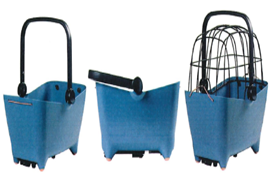
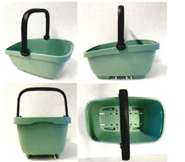
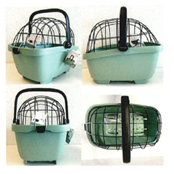
The District Court of The Hague has recently handed down another ruling on baskets – this time concerning rattan baskets with a plastic inner pot. This case also concerns design rights and copyright.
In this context, it is worth noting that in the recently published *Chronicle of Intellectual Property* (NJB 2026/1045), Jorn Torenbosch and Alexander de Leeuw draw attention to two judgments of the Court of Justice of the European Union on design rights and copyright (Mio and Deity Shoes), in which the fundamentally different criteria for protection under design law and copyright are clarified.
For design right protection, the appearance of the design must be new – and this is the case if no identical earlier design was on the market – and must have individual character. The latter is the case if the overall impression on the informed user differs from that (overall impression) of pre-existing designs (the design heritage). The threshold for design right protection is low.
For copyright protection to apply, more is required: the work must be the creator’s own intellectual creation, reflecting the creator’s personality and expressed through their free and creative choices. The threshold for copyright protection is therefore higher.
In the recent rattan basket case heard by The Hague District Court, it was established that the claimant held both a design right and a copyright in the rattan baskets with plastic inner pots that it produced and sold. In the case of the claimant’s basket, known as ‘Drypot’, the rattan was not woven over the base of the plastic inner pot; the base was left uncovered:
(photos from the judgement)
The Drypot rattan basket (with a plastic inner pot) differed in this respect from existing rattan baskets (whether or not they had a plastic inner pot), as all of those have a woven rattan base.
This also applied to the rattan baskets with a plastic inner liner that the defendant manufactured and sold under the name ‘water baskets’:
(photo from the judgement)
The other characteristics of the woven rattan baskets (whether or not they had a plastic inner liner), such as their shape, the weaving technique and the finish of the rim, were otherwise identical for all rattan baskets (those of the claimant and the defendant, as well as those of other suppliers).
The court first held that the scope of protection afforded by the claimant’s design right is limited. The most distinctive feature of the Drypot baskets is the absence of a woven rattan base, whilst the water baskets do not differ from existing designs on the market (the design heritage). This difference is noticeable to the informed user (purchasers of rattan baskets). Since the absence of a base is the most important distinguishing feature of the Drypot designs and the defendant’s water baskets create a different overall impression on the informed user, there is no infringement of the claimant’s design rights.
The court also found that the Drypot baskets are works protected by copyright. The creative choice lies primarily in the omission of the rattan weave across the base. In this case, only creative elements are considered when determining whether an infringement has taken place. The defendant had, in fact, not copied that specific creative element – the omission of the rattan-woven base. As the water baskets do have a standard woven base, there is no similarity relevant under copyright law. There is therefore no question of copyright infringement.
The claimant’s argument regarding slavish imitation also failed. According to the court, the Drypot baskets have only a limited degree of distinctiveness in the relevant market, as many of their external features are common within the existing range of rattan baskets. The only clear distinction lies in the base construction. As the water baskets differ precisely on that point, there is no risk of confusion.
The ruling shows that the criteria for protection under design rights and copyright differ. Even for a validly registered design, the scope of protection is limited. Higher protection criteria apply to copyright, but, as in this case, a single distinctive detail – the absence of a woven rattan base – can be decisive in determining whether or not an infringement has taken place.